

Your Substack Is Either a Client Engine or a Content Hobby
Most creators don’t realise which one they’re building.

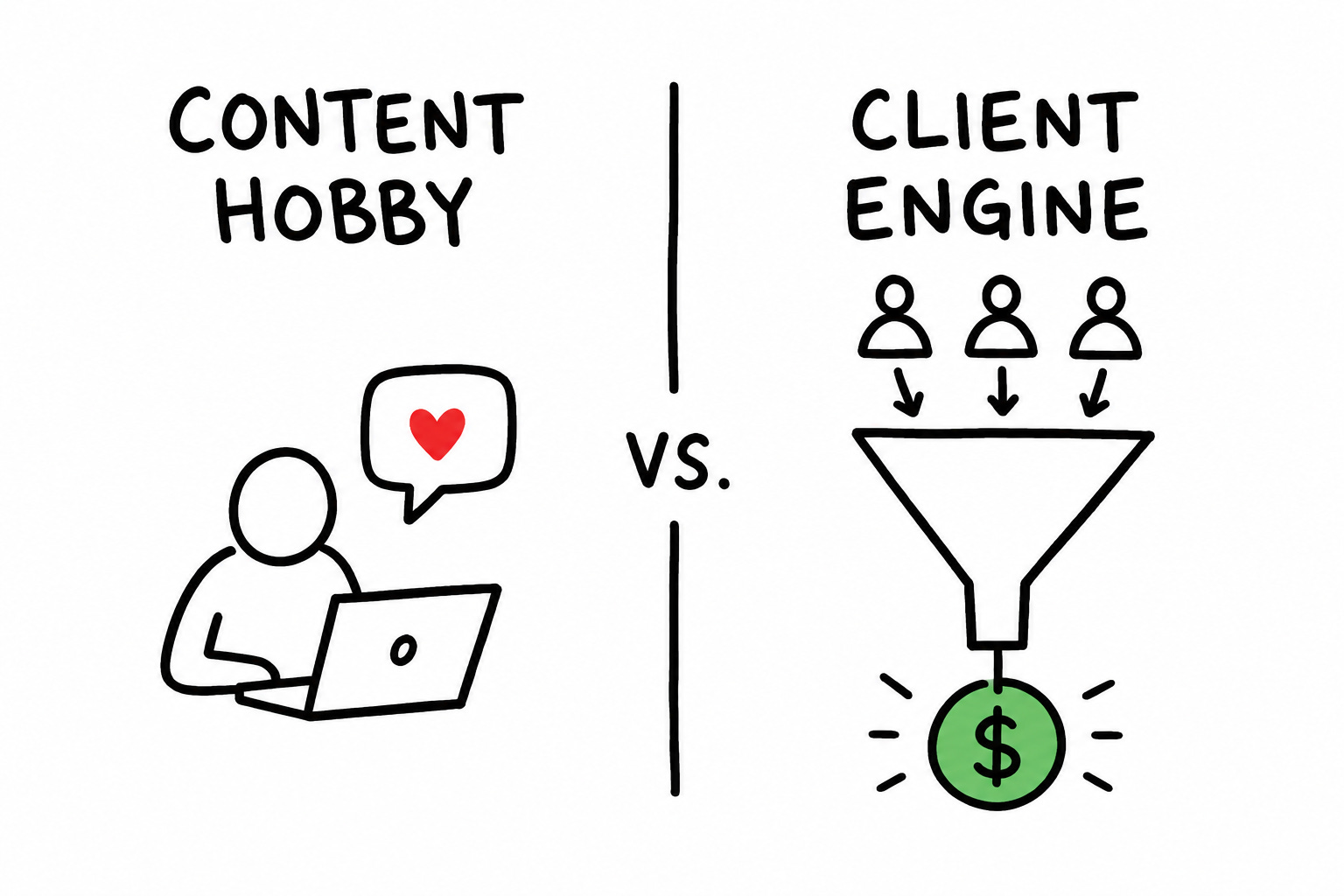
People fail to get clients from their newsletter for a simple reason:
They assume attention automatically turns into clients.
It doesn’t.
A Substack only becomes a client engine when every post quietly moves readers through a simple internal path.
Without that path, even “great content” just entertains people who never buy.
So the real question isn’t “How do I get more readers?” — it’s
“What happens to a reader after they finish my post?”
That answer determines everything.
The Substack Client Engine (Simple Architecture)
Think of your Substack like a 4-stage system:
1. Attract (Attention)
People discover your content.
Notes
Shares
Search
Recommendations
Social posts pointing back
Goal: Get the right people in.
Not everyone. Just the ones with the problem you solve.
It’s why unsubscribes don’t bother me. No sleep lost.
2. Align (Belief Shift)
Your content changes how they see their situation.
This is where most Substacks stop too early.
I think it’s because good ‘alignment content’ is not easy to do, and people aren’t aware. It requires you to actually know a bloody thing about your prospect. To have empathy for them, and not just hog the centre stage yourself.
But done beautifully, it does things like:
exposes a frustration they already feel
names a mistake they didn’t realise they were making
reframes their problem clearly
Example of a belief shift:
“I just need more content” → “I actually don’t have a system that turns readers into clients”
That’s ^^ the belief shift I’m giving you right now. Notice how it affects you. If I do it right, you’ll start saying different things in your mind about your Substack and what you should do next.
Goal: Create recognition that you are an authority in your space, and that you understand the reader. You’re not just information.
3. Activate (Next Step)
Now, this is where most newsletters break, so the clients never come.
Every post should quietly answer:
“What should I do next if I agree with this?”
That “next step” is not always a hard sell. In fact, it rarely is.
It can be:
a lead magnet (I prefer a ULM)
a simple CTA to learn more
an actual landing page
a “book a call” link (my least favourite)
or even simply asking for a reply
But whatever you do, the ‘Next Step’ must exist.
Without it, you have content. Not a client-getting system.
Goal: Turn belief into motion.
When consuming your newsletter causes people to take action, it means your “Client Engine” is warming up. It’s an exciting stage because it’s proof that your message is sharp enough and people want to know more.
4. Convert (Offer Clarity)
This is where readers become clients.
Your offer doesn’t need more persuasion. This is a mistake. Too much persuasion and you’ll end up attracting clients who need to be heavily ‘sold’, and will need a lot of hand-holding. You’ll also drift into ‘used-car salesman’ territory, stretching truths and making bold promises outside of what you can comfortably (and consistently) deliver.
No, instead, your offer needs more clarity.
Strong conversion happens when:
the problem is specific
the outcome is obvious
the path is simple
the timing feels urgent
Weak conversion = “coaching / consulting help for your business”
Strong conversion = “I help coaches turn Substack readers into paying clients without social media” — or whatever your specialty is.
Goal: Make the decision obvious, not dramatic.
What Most People Are Doing Instead
Most Substacks accidentally become:
interesting essays
personal thoughts
tactical tips
growth content
storytelling archives
All of that can be valuable, yes… but none of it forms a system.
So the reader experience becomes:
“That was useful.”
closes tab
forgets about it
No next step. No momentum. No conversion.
The Shift That Changes Everything
Look, if you fix one thing, fix this:
Every post must contain a path, not just a point.
Ask:
Does this attract the right person?
Does this reframe how they think?
Does this point them somewhere specific?
Does it naturally connect to my offer?
If the answer is no to any of those, it’s content — not infrastructure.
The Takeaway
Putting out a new post every week is great, for many reasons, so yes, do this.
But you need posts that move people somewhere on purpose.
That’s the difference between:
being read, vs
being paid
Fast track:
Last year, 45% of my business came from Substack. One such example is here.
I help people get clients. If you’re curious how, check the 2 videos on the page linked below. One video is about how it works, and the other is a testimonial from a client where we had to turn his marketing off because he had too many clients:
Thanks for reading
See you next time.
Cheers,
Pat
PS: Make it to the end? I’m grateful for the free info I had back in the day, and am honoured to pass my lessons on. Hitting ❤️ tells me this was useful.
This all makes sense (a lot of sense, actually).